

OpenClaw scaled because of a simple insight: the UNIX filesystem is a good operating surface for agents. Not just for storage, but as a read-write-edit interface.
If an agent can read, write, edit, and search files, it can do a surprising amount of useful work. It can inspect the current state of the world. It can modify that state. It can keep versions through Git. It can recover when something goes wrong. It can use commands like `ls`, `cat`, `grep`, `find`, `head`, and `wc` without needing a new API for every small action.
That is a strong primitive.
But the ordinary filesystem has limits.
It is not where most data lives. Your context is spread across Postgres, Mongo, Redis, Elasticsearch, S3, Slack, Google Drive, remote server files, docs systems, logs, tickets, traces, and many other places.
Moving back data from a specialized index back to ordinary filesystem may not be feasible.
Also, normal filesystems are not great at many things agents need: indexing, metadata, filtering, and efficient search over large collections.
Databases already solve many of these problems.
So maybe the answer is not to force everything into files. The better move is to expose databases through the same interface as a standard filesystem.
Database as virtual filesystem
The agent keeps the simple interface. The backend gets to remain specialized.
`ls` can list folders, tables, collections, channels, documents, or query namespaces.
`cat` can read a file, row, document, message, page, or stored context item.
`find` can traverse the virtual hierarchy.
`grep` can search content, ideally by using the backend’s native index instead of downloading everything and scanning locally.
In summary: keep the filesystem API as the agent-facing operating surface, but let the system underneath route those commands to the right database, index, object store, or SaaS tool.
Several recent efforts point in this direction.
Virtual Filesystems for Databases
LangSmith Agent Builder treats agent memory as files: AGENTS.md, skills, tools.json, and knowledge files. The interesting part is that these do not have to live on a literal filesystem. They can be stored in Postgres while still being exposed to the agent as files. The agent gets a familiar workspace. The system gets database-backed persistence and management.
Mintlify built ChromaFs, a virtual filesystem over Chroma. Their docs assistant could use commands like ls, cat, grep, and find over indexed documentation. This made the docs corpus feel like a filesystem to the agent, while avoiding the cost and latency of spinning up a real sandbox for every session.
Leonie Monigatti implmented one with Elasticsearch. The virtual filesystem supports the core Bash commands, but the backing store is an Elasticsearch index. The useful detail is how grep works: first use Elasticsearch regex for coarse search, then do more exact filtering in memory. That is the kind of translation layer these systems need.
Both above rely on just-bash by Vercel Labs, a TypeScript reimplementation of bash that supports
grep,cat,ls,find, andcd. just-bash exposes a pluggableIFileSysteminterface, so it handles all the parsing, piping, and flag logic while (for Mintlify) ChromaFs translates every filesystem call into a Chroma query.
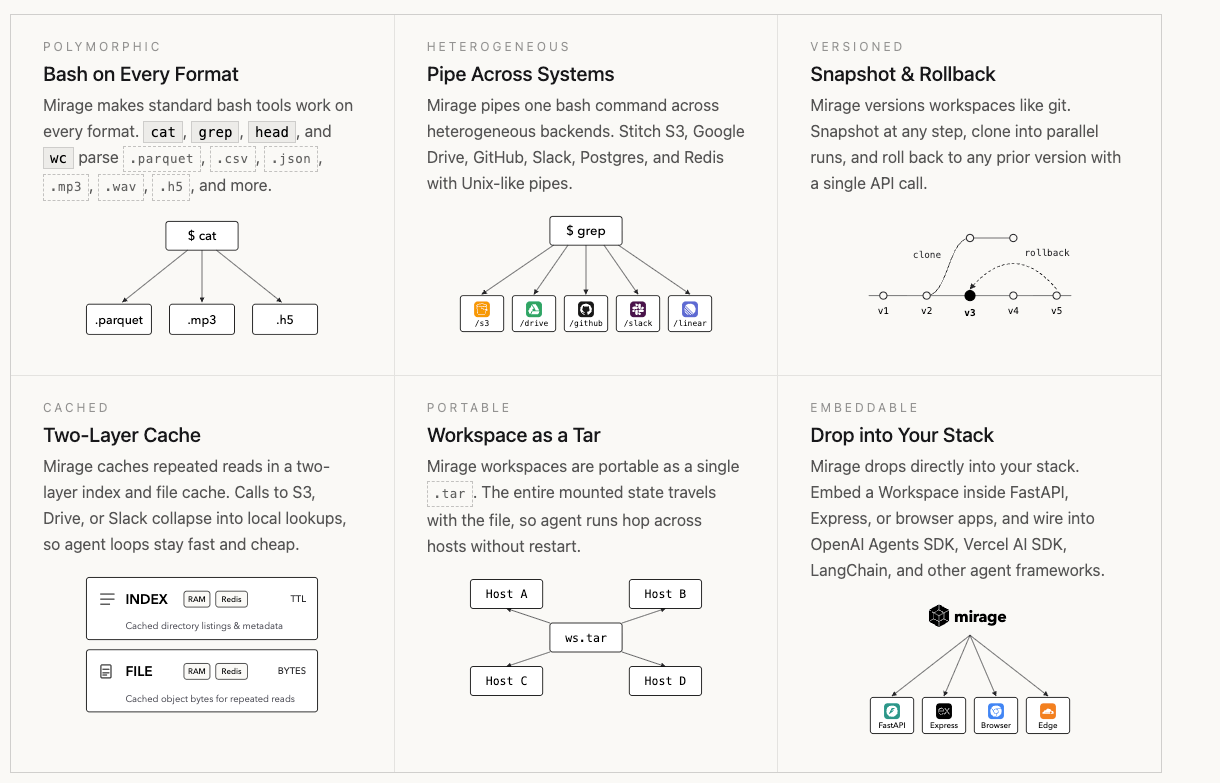
Mirage pushes the idea further. It tries to expose many data sources as one universal filesystem workspace: S3, Google Drive, Slack, Postgres, Mongo, Redis, remote files, and more. The agent can run familiar Bash-like commands across all of them.
A virtual Bash interface over popular DBs is powerful. The agent does not need a different interaction pattern for every data source. It can inspect heterogeneous systems through one modest interface, without changing its workflow.
What’s the catch?
What does grep mean on S3? Does it download files, stream them, use an index, or run remotely?
What does cat mean on a huge database table? (Mirage turns rows into JSON format)
What does ls mean over Slack?
Are permissions inherited correctly from the source system?
Are search semantics the same across Elasticsearch, Chroma, Postgres, object storage, and Google Drive?
This is where the abstraction gets tricky.
A universal Bash interface for agents is welcome news. The common set of Bash commands: ls, cat, grep, find, head, and wc are boring commands, but boring is often what makes an interface useful. Models already understand them. Developers understand them. Workflows compose around them.
But the hard part is making the abstraction cheap, faithful and predictable enough for agents to rely on it.
If that happens, then we will have extended society of Agents.
Talking seamlessly to many databases, indices, object stores, and SaaS tools
Exposed through the simple, modest filesystem interface, which agents already know how to use.