

The Voice AI model space could be earlier split into two broad categories: cascaded models (STT → LLM → TTS) vs single voice-to-voice model. With OpenAI’s GPT-Live-1 and Nvidia’s Nemontron VoiceChat, we now see further fragmentation to handle long running tasks.
A live voice agent has to do two things:
Manage the conversation in real time. [real-time interaction] It must track incoming audio while speaking, decide whether a pause means “keep listening” or “take the floor,” and handle interruptions. Delaying these decisions until a full turn ends makes the interaction feel less natural.
Solve the user’s task. [asynchronous task dispatch] That can mean a quick reply, or it can mean searching, calling tools, and reasoning through a more involved problem.
So, a voice agent must two meta-channels, for interaction and tasks.
Two Channels - Interaction and Task
The first channel handles only the user interaction (listening, fast thinking, speaking), while the other handles complex tasks (slow thinking).
The Interaction Channel, handles user interaction: listening, fast thinking, speaking. It works over two channels, one each for user and agent activity.
The Task Channel selects and executes tasks via reasoning and tool calls, whose results provide context for the Interaction Channel.
Full Duplex Models
Traditionally, user and agent take turns listening and speaking on their individual channels (like on a text chat). So, effectively user and agent interact via a single channel. This is called half duplex mode of interaction.
However, humans don’t take strict turn in natural voice conversations — they may interrupt, give short i-am-listening feedback (backchannel, like "mhm" or "yeah") and overlap while speaking. For Voice AI to sound natural, we need two channel, full duplex mode of interaction.
The Moshi full duplex model (late 2024) showed for the first time how voice AI models could work with two channels. Moshi is a single model for direct voice-to-voice interaction in real time, without intermediate conversions: voice → text → voice. The disadvantage of having a single model: it is hard to control speech characteristics (prosody, cadence, volume, fast/slow), floor negotiation (when to take the floor or backchannel or let user interrupt) and instruction following.
Since then there is a flurry of voice models have tried to improve it to achieve the magic combination:
single full duplex model
+ real-time interaction
+ steerable/controllable
+ handle long running tool calls.
GPT-Live and VoiceChat model
GPT-Live-1 from OpenAI and VoiceChat (11B) model from Nvidia, both released in 2026, are the latest full duplex models. However, they differ in their architecture.
Interaction Channel.
VoiceChat has multiple components: a speech encoder, an auxiliary transcription branch, and a separately trained TTS decoder.
GPT-Live-1 has a single component live model which handles all aspects of audio interaction.
Task Channel.
GPT-Live-1 uses an optional backend reasoning model for slow, delegated work. So effectively it is a two-part, vertically cascaded model: a live model and a backend model.
VoiceChat attaches a tool-call channel to the main interaction model. Both interaction and reasoning for tool call selection-generation happen in the main model.
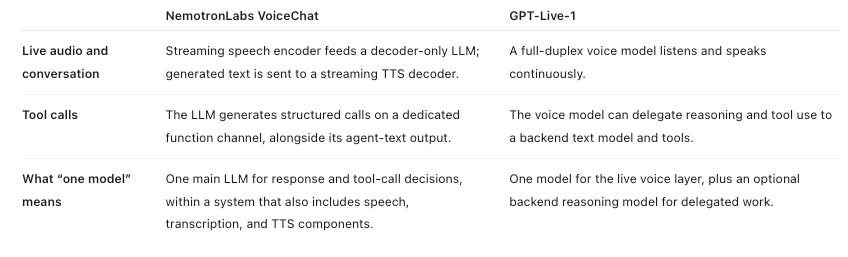
Why split the model vertically (reasoning axis) ?
For:
Keep the voice path responsive. If a backend takes time to search or reason, GPT‑Live can continue talking or listening while it runs. That’s the central advantage OpenAI describes.
Update the backend independently. GPT‑Live can use different frontier models behind the voice layer. The backend can be chosen for reasoning depth, tools, cost, or workload, while the live model stays tuned for voice interaction. Use a stronger or more suitable model for hard tasks.
Against:
Keep tool behavior in one streaming policy. VoiceChat’s single-model approach can jointly produce conversational text and structured calls on parallel channels. That can reduce orchestration overhead and keep tool decisions tied to the same live context.
While VoiceChat accurately identifies the correct tool to use 82.5% of the time, it currently struggles with precision when filling out the specific parameters/arguments for those tools (dropping to a 44.2% argument accuracy split)
In any case, both models need to make decisions to delegate tasks with unpredictable latency, either via tool call or by delegating to another model. Worth noting that VoiceChat’s live model has multiple components, which can also be swapped with better models. GPT-Live and VoiceChat chose different modular boundaries.
Nemotron VoiceChat: the conversation waits for the tool
The main language model has two output channels: an agent-text channel and a structured function-call channel.
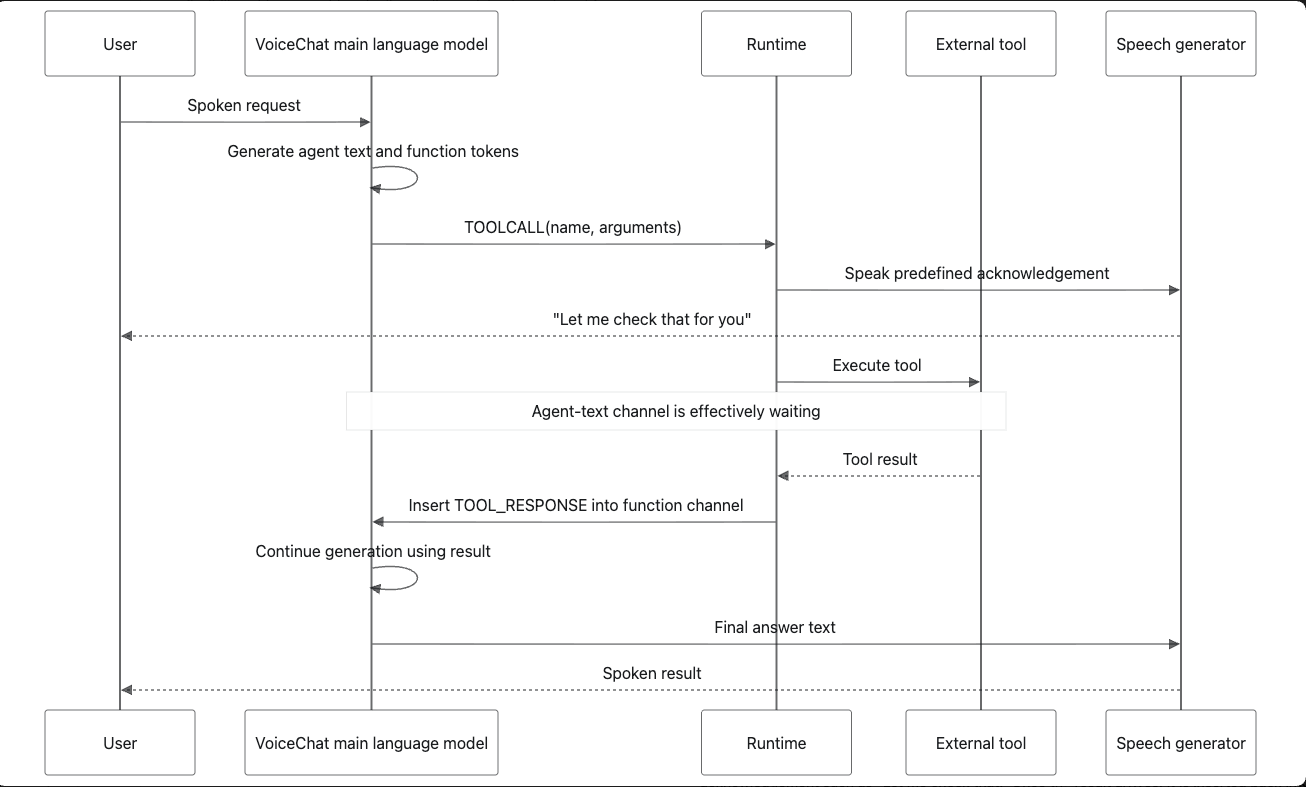
When the function channel emits a complete call, the runtime executes it. During that interval, the normal agent-text positions were trained as padding. At inference time, the runtime replaces that silence with a predefined acknowledgement such as “Let me check that.” Once the result arrives, it is inserted back into the function channel and the same language model resumes generation.
To make the conversation sound natural, the acknowledgement must be long enough to mask the tool delay. Limitations:
long tool responses delay subsequent speech
the user cannot barge in while a tool is executing
simultaneous tool invocation is not yet reliable
multi-step calls happen sequentially through repeated call-and-result cycles.
So VoiceChat has a unified decision path, but its runtime is not a general asynchronous job manager. Its acknowledgement only masks the tool call latency, but is not a concurrent conversation.
GPT‑Live: the voice conversation and job have separate lifecycles
GPT‑Live creates a delegation identifier. The application or managed Responses backend uses that identifier to associate later progress and results with the correct task. Interrupting the spoken conversation does not cancel backend work.
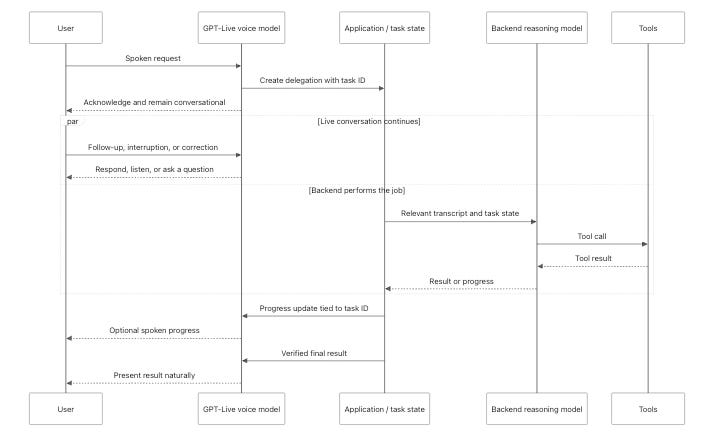
Here’s a scenario which GPT-Live can handle better than VoiceChat: user changing their request.
Suppose the user says:
“Book Friday at 2.”
The backend starts checking Friday. The user then says:
“Actually, make it Thursday.”
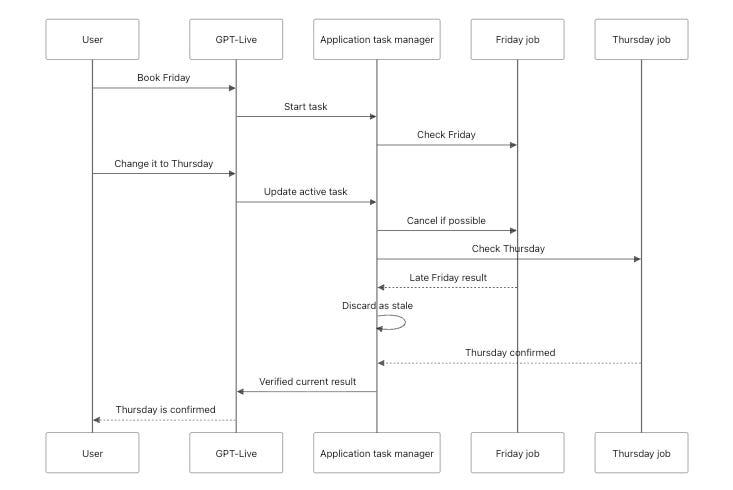
Recap
Both VoiceChat and GPT-Live-1 are powerful, realtime voice models, showing that real-time voice-to-voice models are indeed feasible for practical voice AI scenarios. The two models have different architectures, particularly how they choose to handle long running background tasks. Older voice AI models are built on horizontally cascaded components (STT → LLM → TTS). GPT-Live-1 introduces a vertical cascade: delegating to another text model, which can do slower, complex reasoning. In fact, OpenAI’s delegation mode allows the backend to be any model, agent, workflow, or service. A puzzle that remains: can a single live model handle asynchronous jobs also? If it can, is that a good idea vs vertical cascade?
The 44.2% argument accuracy against 82.5% tool selection for VoiceChat is the number that stands out to me. In a voice setting a wrong argument is expensive because the acknowledgement has already been spoken and the user cannot barge in during execution. Would a cheap validation or confirmation step on the arguments before the call fires be worth the extra latency, or does that break the single streaming policy argument?