

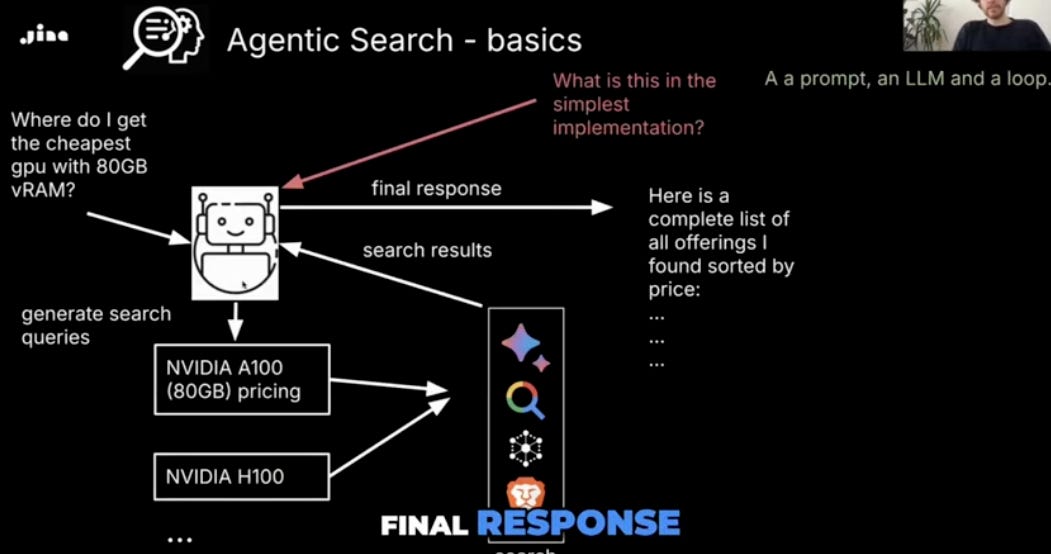
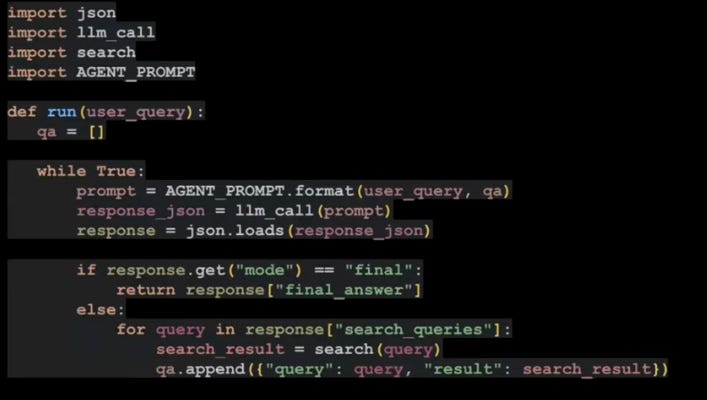
The sequential DeepResearch/Agentic search pipeline looked like this:
A New Parallel Agentic Search Pipeline
Sequential search can be slow if the query requires a broad set of evidences.
Databricks’ simplified, scalable Search pipeline has two elements:
rewrite, fire queries in parallel. This increases recall because more query variants bridge to broader variety of documents
merge and rank the document results from each query. This increases precision because better ranking will bring up more relevant documents to top.
Their trained Instructed-Retriever-1 model works well for both fact-oriented queries as well as those asking for summaries.
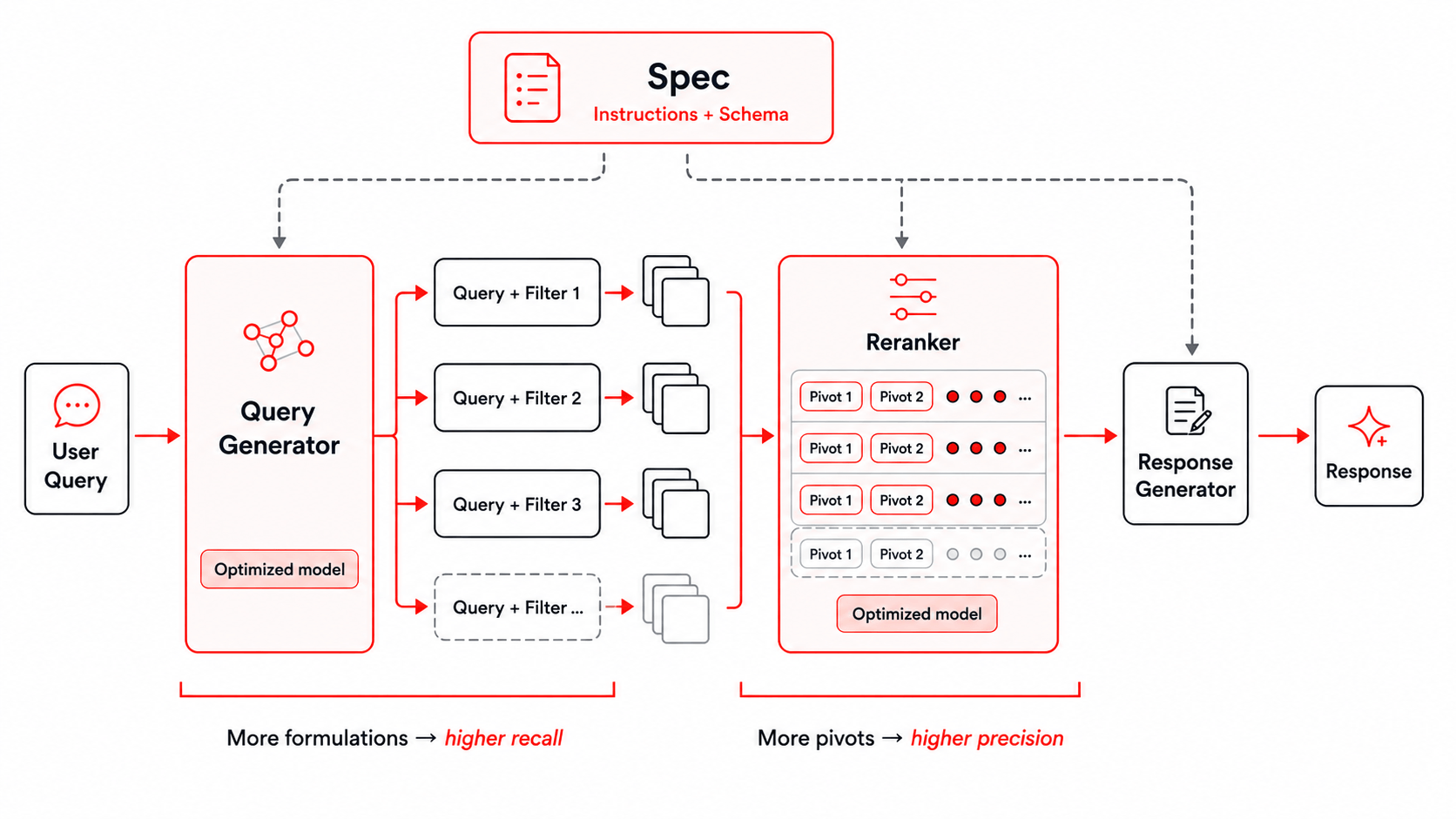
The catch is how to effectively implement the second step: how do we systematically merge and rank hundreds of ranked lists (one per query) returned as first stage results?
They introduce a multi pivot reranking scheme. I find it easier to view it as a simplified clustering algorithm, which does a single pass on streaming results.
Picks a set of pivot documents, that serve as distinct information source. like centroids of different clusters.
When a new document arrives, compare against existing pivots to see if it better captures the source
They don’t update the pivot (like updating centroid). Instead they rank similar documents around a pivot based on relevance to query (group-wise scoring).
Use the pivots as common anchors to normalize relative scores across groups.
The system merges these normalized relative positions into one final top-to-bottom master list.
This is a simple and scalable approach to merge-and find relevant documents (pivots are the top relevant documents), which also ensures diversity of information sources.
The system gets the best of both worlds:
High Precision: Candidates are judged with full relative context against strong pivots.
Low Latency: Group comparisons run simultaneously across GPU workers rather than step-by-step, making it fast enough for production search.
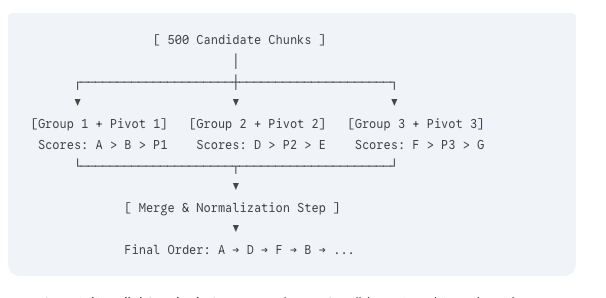
Deeper: Meaning of relative context?
The Problem with Single-Document Evaluation: Normally, if a model looks at Document A by itself, it can only give a crude absolute score (e.g., “This looks somewhat relevant, 7/10”). It doesn’t know if Document A is missing critical details compared to other results.
The Solution : Instead of judging Document A alone, the system places Document A right next to a “pivot”—a high-quality anchor chunk (the strong benchmark) that is known to contain key information.
Full Relative Context: Because the model reads both chunks in the exact same prompt window, it can make a direct head-to-head comparison:
“Compared to Benchmark Chunk X, Candidate Chunk A adds a new constraint about 2024 pricing, but omits the hardware specs. Therefore, Chunk A is slightly less relevant than X, but better than Chunk C.”
This direct side-by-side comparison gives the model relative context, allowing it to spot subtle differences in accuracy, detail, and quality that it would miss if evaluating documents in isolation.
Also interesting is that they trained a single model on synthetic data that can both rewrite queries and groupwise rank documents. There’s low similarity between those two problems but it is great to have a single model do that, which also has much low latency than frontier GPT-5+ models.