

You’ve probably heard about the standard (R)etrieval (AG) recipe for finding answers to queries: chunk documents, embed chunks as numeric vectors, similarity search with queries, then LLM. You’ve also heard the backlash: this approach is chunk-sensitive, too non-contextual, doesn’t work alone, needs fine-tuning, brute-force and so on.
Add hybrid search, hierarchy, contextualization, graphs, rerankers, agent loops, or switch to something like PageIndex and say: this is vectorless, don’t need vector embeddings anymore! LLMs will handle long documents directly.
This is where the discussion gets muddled.
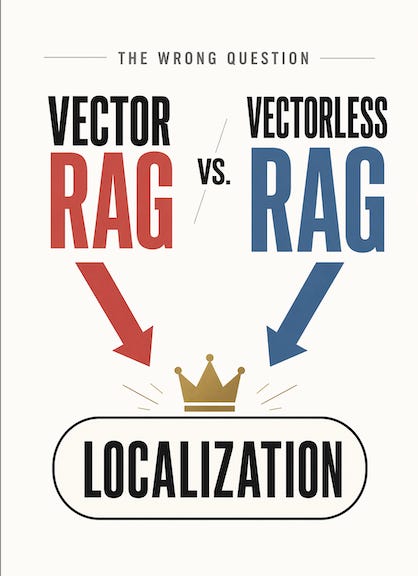
Most RAG debate compares implementations (how), not retrieval strategies (what/why). We keep enumerating methods instead of forming a domain understanding.
There is naive RAG, advanced RAG, GraphRAG, HippoRAG, PageIndex, Hindsight, and so on.
Next, we fall back on weak empirical takes or social media commentary: RAG is dead, GraphRAG is better, or you rarely need GraphRAG. All you need is Memory.
It is easy to add another X-Rag to the list. Happens on a daily basis.
Why? Lack of clarity on what any of these methods is trying to achieve.For example, how does the default chunk-embed-match method compare to the newer pageindex method? The latter claims they are vectorless - is that the key differentiator?
Not knowing the what and why of a retrieval method pushes the engineer to keep switching methods and retuning knobs. There are hundreds of those knobs floating around. Different ways to chunk, embed, fine-tune, rerank, filter, graph ANN configurations, graph representations, ingestion configs, memory formats and so on.
I’ve seen teams waste months tweaking configurations before they realize what is actually wrong with their search engine.
One of the core retrieval problems is simpler than the jargon makes it sound: localization.
Localization Is the Core Retrieval Problem
Localization is the art of narrowing down from a huge corpus to a much smaller subset that is likely to contain the answer.
Say you have a million documents. In comes a query. The retrieval system cannot brute-force compare the query with the whole corpus in one shot. Many reasons why: queries span many attributes, keywords vs metadata, could be multi-hop and so on.
The system needs to localize: reduce that million to a few tens or hundreds of candidate documents, sections, or chunks that plausibly contain the answer to the query. Localization must be efficient. Once done, examine the localized candidates to extract the final answer (say, by reasoning using LLM).
Once you think this way, many retrieval methods become easier to compare.
Not “vector vs vectorless.”
Not “old RAG vs new RAG.”
Not “LLM-based vs classical.”
The real question is: how does this system localize?
A vector-full approach localizes by
hashing (embedding) each document into a small vector, hashing the query too,
scoring query vs all documents at scale,
then filtering the top-K results.
In short: hash -> score -> filter. Each stage determines how efficient overall localization is.
A vectorless approach like PageIndex localizes differently.
It builds a hierarchy of sections, tagged with summaries of what lies below. Intuitively, a table of contents, tagged with per item summary.
The query is matched against that structure, iteratively top-down or one-shot
and the engine narrows toward the sections most likely to answer it.
once localized, reason through the full sub-documents, or redo localization.
The first approach compares the query against everything in one flat sweep. The second one uses structure to progressively narrow the search space. The retrieval policy is tree-guided rather than pool-wide.
The important distinction is not really vector-full vs vectorless.
Both are trying to do the same thing:
Localize the query to a smaller relevant region of the corpus.
Once you see this, a lot of noisy debate becomes easier to parse. Embeddings are an implementation choice. LLM reasoning is an implementation choice. Summaries are an implementation choice. Even “vectorless” is just a description of one mechanism. Those are all answers to how.
It was never about vectors or LLM magic. What we really care about is efficient localization.
In fact, the key question is:
Which localization strategy works best for your problem?
More broadly, it is not just about Search. Localization is core to keeping context compact/relevant inside Agents (harness engineering).
We’re perfectly content if classic grep is enough to zero in to the right code parts.
Avoid Arguments about How Before You Know the Objective
A lot of retrieval discussion goes in circles because the objective is never made explicit.
Engineers switch methods without a clear model of what changed. They compare branded systems instead of comparing retrieval policies.
That is what makes search feel more mysterious than it is.
If you can clearly state how your system localizes to relevant documents, you are already thinking at a more useful level than most RAG discourse.
Too much discussion lives in the how. The interesting part is usually the what.