

A lot of RAG debugging (Agentic Search in 2026) starts the same way: try better chunking, add metadata, add reranking, switch on hybrid search, try HyDE, rewrite the query, add table summaries, test a few more examples.
Some of these fixes may help. But unless you know what failure you are fixing, this is mostly expensive guessing. When RAG quality is unstable, the temptation is to keep adding fixes. The better first question is: what exactly is broken?
Most engineers can now recite the common RAG fixes I mentioned above. Unfortunately, they see these fixes as quick knobs to experiment with. Trying these one after another can lead to months of wasted effort, debugging fatigue, and deep frustration.
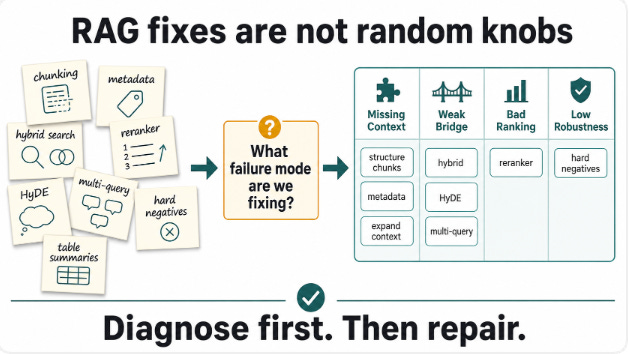
What’s the solution then? The harder part is knowing which trick matches which failure. A reranker, for example, helps when the right chunk is already retrieved but buried too low. It does not solve the same problem as better chunking or HyDE. Identifying the right failure mode quickly is far more important than the specific fix you try.
Failure Modes of Agentic Search?
One useful way to think about RAG is how to setup bridges between what the user asks and where the answer lives in your documents. A bad answer usually means one of those bridges failed: the system did not retrieve the right evidence, retrieved it but ranked it poorly, retrieved without paying heed to the surrounding context, or could not distinguish the correct chunk from a similar but wrong one.
These are different failure modes and each mode comes with its own bag of fixes. That is why I prefer grouping RAG fixes by failure mode instead of treating them as a checklist.
The first failure mode is Missing Context.
Sometimes the retriever finds the right paragraph, but the generated answer still feels incomplete or brittle. The paragraph may mention the answer, but not the section logic, assumptions, definitions, or surrounding details needed to use it correctly.
That is the problem structure-aware chunking tries to solve. Chunking by document structure instead of fixed token count keeps paragraphs closer to the section they belong to. Metadata such as section name, fragment title, date, or source gives the model additional placement context. And retrieving small chunks but passing a larger surrounding window to the LLM helps the system zoom out before generating.
The goal is not simply better chunking. The goal is to restore enough context for the answer to be correct and make sense.
Second failure mode: Weak query-document Bridge.
Sometimes the answer exists in the corpus, but the user’s query does not connect cleanly to the document text. This happens with short queries, vague queries, synonyms, domain-specific phrasing, and tables.
A couple of different fixes work here, depending on why the query failed to connect.
Hybrid search helps because keyword search and semantic search catch different kinds of relevance. HyDE helps when the original query is too thin, by creating a richer retrieval target. Multi-query retrieval helps by searching from several phrasings or intent guesses. For tables, summaries often work better than raw embeddings because they turn rows and numbers into language the query can match.
Again, the goal is not to try HyDE or use hybrid search. The goal is to make the user’s question easier to connect to the right evidence.
The third failure mode is Bad Ranking.
Sometimes the right chunk is retrieved, but it appears too low in the list. To a user, that might mean it is never seen. To an LLM, it means the useful evidence may be diluted by earlier noisy chunks.
That is where rerankers help. They do not necessarily expand what you retrieve; they improve the order of what you already found. The goal is to put the best evidence at the top.
Fourth failure mode: Weak Generalization to new queries.
A RAG pipeline can look good on easy examples and still fail in production. The real test is whether it can choose correctly when several chunks look similar, but only one is actually right.
That is why hard negatives or hard distractors matter. They test whether the retriever and the overall pipeline can distinguish close matches from correct matches. That enables generalization to unseen production queries.
So instead of asking, “Should we add HyDE?”, “Should we use hybrid search?”, or “Should we change chunk size?”, ask a more basic question first:
What kind of failure are we seeing?
Is it missing context?
A weak query-document bridge?
Bad ranking?
Low generalization?
Agent’s plan is incomplete
…
In practice, failure modes rarely show up cleanly. They are often entangled, and one failure can look like another.
A missing-context problem may look like a weak bridge problem.
A ranking problem may look like a generation problem.
A weak query-document match may look like “the model is hallucinating.”
So diagnosis takes effort and practice. You have to inspect execution logs, review retrieved chunks, look at failed queries, compare near-misses, and study the data closely.
I’ll be writing more on this topic. Subscribe to this series, and follow my YouTube Agentic Search series for deeper walkthroughs.
Related Posts:

